
Understanding Prime Numbers in C#
Prime numbers are a fundamental concept in mathematics and computer science. In this tutorial, you'll learn how to check if a number is prime in C# using a simple yet efficient algorithm. This guide is designed for beginners, students, and teachers who want to combine math programming tutorials with practical coding exercises.
What is a Prime Number? | Maths Explanation for C# Kids
A prime number is a natural number greater than 1 that has no divisors other than 1 and itself. For example, 2, 3, 5, and 7 are prime numbers. Understanding prime numbers is essential for C# math projects and coding challenges.
The Intrique of Prime Numbers | Explanation for C# Kids
Prime numbers are tricky to spot.
A number that looks like a prime may in fact be a multiple of a smaller prime number.
C# Prime Number Logic Explained
To perform a prime number test in C#, we check whether a given number is divisible by any integer other than 1 and itself.
The basic idea of the C# prime number algorithm is:
- If the number is less than or equal to 1, it is not prime.
- Try dividing the number by integers starting from 2.
- If the number divides exactly by any value, it is not prime.
- If no divisors are found, the number is prime.
This logic is commonly used in C# number algorithms for beginners.
Create a new C# Class file;
Call it CheckPrime.
Type out the adjoining C# code for checking for primeness.
Efficient C# Prime Number Test Using Square Root Method
Since the world is always in a hurry, we can make use of a
little extra speed.
This C# code example shows how to check if a number is prime using a fast algorithm based on complementary factors.
A more efficient way to check for primeness in C# is to test divisibility only up to the square root of the number. This reduces the number of calculations and improves performance.
By limiting checks to the square root of the number, this fast prime number check in C# ensures efficiency even for larger numbers. This method is widely used in programming competitions and educational exercises.
Base Theory of Quick-Check for Primeness in C#
Consider the number 36; Its factors are:
Every factor of 36, when arranged in ascending or descending order, can be divided into 2 equal parts at the position of its square-root.
It is easily seen that every factor of 36 on one side of the divide has a complementary factor on the other side.
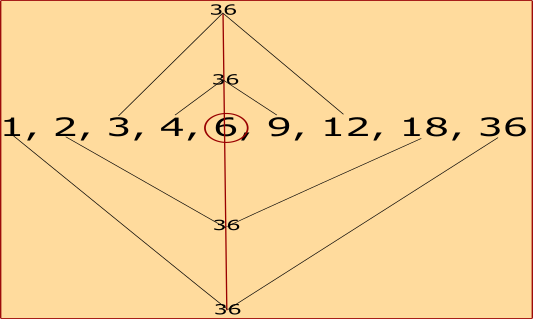
Hence, we can search for only a particular group of factors, (preferably the more compact group, i.e, between 1 and \(\sqrt{36}\)) to see if 36 has any factors.
Fast Check for Primeness in C#
So for our quick prime number check C# algorithm, we will use the range of
2 to \(\sqrt{number}\).
Type out the adjoining C# code for fast prime number check.
Prime vs Composite Numbers in C#
- Prime numbers have exactly two factors.
- Composite numbers have more than two factors.
- The number 1 is neither prime nor composite.
Understanding the difference between prime and composite numbers is important when working with C# math programs and number-based logic.
Why Learn Prime Numbers with C#?
Combining mathematics with programming makes learning more engaging. Teachers can use this as a math programming tutorial for kids, while learners can practice C# coding exercises that strengthen both logical thinking and problem-solving skills.
Key Takeaways from C# Check Prime Number Algorithm
- Prime numbers are divisible only by 1 and themselves
- C# can easily test prime numbers using loops
- Optimized prime checking improves efficiency
- This logic is ideal for beginners and students
Summary: How to Check If a Number Is Prime in C#
To check if a number is prime in C#:
- Ensure the number is greater than 1
- Test divisibility using a loop
- Use an optimized approach for better performance
These methods form the foundation of many C# prime number tutorials and help learners understand loops, conditions, and algorithms.
So! C# Fun Practice Exercise - Check Prime Number
As a fun practice exercise, feel free to try out your own numbers, and see how the C# code checks the numbers to ascertain which ones are prime numbers.
C# Code for Checking Prime - Class File.
namespace Arithmetic
{
class CheckPrime
{
private int prime_suspect; // We suspect that this number is prime
private double square_root; // this variable is a helping one.
public CheckPrime(int val)
{
// let's see whether prime_suspect is at a premium(is a prime).
prime_suspect = val;
square_root = Math.Sqrt(prime_suspect); // Get square root
}
/**
* Does the actual evaluation to see if our number is prime.
* @return boolean value
*/
public bool verifyPrime()
{
/* Loop through searching for factors. */
for (int i = 2; i < prime_suspect; i++)
{
if ((prime_suspect % i) == 0)
{
return false;
}
}
// If no factor is found:
return true;
}
}
}
C# Code for Checking Prime - Main Class.
using System.Collections.Generic;
namespace Arithmetic
{
class Program
{
static void Main(string[] args)
{
Console.WriteLine("Welcome to our demonstration sequels");
Console.WriteLine("Hope you enjoy (and follow) the lessons.");
Console.WriteLine("\r\n");
/*
* Test for the primeness of a number.
*/
int test_guy = 97;
CheckPrime prime_check = new CheckPrime(test_guy); // Is 97 is prime number?
string result = "Prime State:\r\n";
if (prime_check.verifyPrime())
{
result += test_guy + " is a prime number.";
}
else
{
result += test_guy + " is not a prime number.";
}
Console.WriteLine(result);
}
}
}
C# Code for Checking Prime Fast - Class File.
namespace Arithmetic
{
class CheckPrimeFast
{
private int prime_suspect; // We suspect that this number is prime
private double square_root; // this variable is a helping one.
private int test_range; // range for minimal looping
public CheckPrimeFast(int val)
{
// let's see whether prime_suspect is at a premium(is a prime).
prime_suspect = val;
square_root = Math.Sqrt(prime_suspect); // Get square root
test_range = (int)Math.Ceiling(square_root); // Extract an absolute value
}
/**
* Does the actual evaluation to see if our number is prime.
* @return boolean value
*/
public bool verifyPrime()
{
/* Loop through searching for factors. */
for (int i = 2; i < test_range; i++)
{
if ((prime_suspect % i) == 0)
{
return false;
}
}
// If no factor is found:
return true;
}
}
}
C# Code for Checking Prime Fast - Main Class.
namespace Arithmetic
{
class Program
{
static void Main(string[] args)
{
Console.WriteLine("Welcome to our demonstration sequels");
Console.WriteLine("Hope you enjoy (and follow) the lessons.");
Console.WriteLine("\r\n");
/*
* Test for the primeness of a number.
*/
int test_guy = 97;
CheckPrimeFast fast_check = new CheckPrimeFast(test_guy); // Is 97 is prime number?
string result = "Prime State:\r\n";
if (fast_check.verifyPrime())
{
result += test_guy + " is a prime number.";
}
else
{
result += test_guy + " is not a prime number.";
}
Console.WriteLine(result);
}
}
}